

Merger Update
It feels like the main opposition to merger is giving up. Or at least they should if this is all the defense they’re going to muster.

Just in time for your comatose, post-meal malaise, here’s a roundup of recent merger news. It’s been a bit sleepy for the past month or so, up until a number of actions became public more recently. Here are 3 key points to help find the signal from the noise.
1. UP is doing all the right things
I published “Lose the PR Battle, Lose the War” back in September, aptly written right before Mr. Vena goes to Washington. In that article, along with a photo of anti-merger advocate Keith Creel standing with US Commerce Secretary Howard Lutnick, I highlighted how UP and NS were losing the PR battle:
“So given the importance of having the Trump administration on their side, why hasn’t Jim Vena and Mark George jumped on a plane to Mar-a-Lago to kiss the ring? Why weren’t they in Lutnick’s office within a week of the merger announcement? Take a leaf out of Nippon’s playbook in their very public acquisition of US Steel. Japanese executives recognized the political hot potato during an election year and made all sorts of concessions and trips to the US to get the deal done.”
Since that time, UP has made several important moves:
CEO Jim Vena did kiss the ring and got President Trump’s “ringing” endorsement, “Sounds good to me.”
UP followed up that visit by donating to the President’s pet project of remodeling the White House.
UP secured key union support by getting SMART-TD to do a 180 and support the merger, making it all the more easy for a populist president to support the merger.
Industry and mainstream media were treated to a ride through Chicago, the epicenter of any improvements that would deliver streamlined service for shippers.
In an effort to allay fears raised by the Anti-Merger crowd on a potential disruption from IT system integration, UP CIO Rahul Jalali is making the rounds saying that won’t happen this time. (I don’t know that this really means anything, but at least they recognize the issue).
These are all good moves and should be positives for UP in positioning themselves well for the STB review. What more can they do? Flip chemical shippers.
2. The Anti-Merger crowd is only positioning for handouts now
It feels like the main opposition to merger is giving up. Or at least they should if this is all the defense they’re going to muster.
Trade associations will still make noise and individual shippers will negotiate for deals like rate freezes in exchange for supporting the merger. BNSF and CPKC have continued to make some noise with BNSF publicly urging shippers to speak up. But if no one is willing to engage the White House directly then what’s the point? That’s the real litmus test and the White House has made it clear that they don’t want to hear from the trade associations.
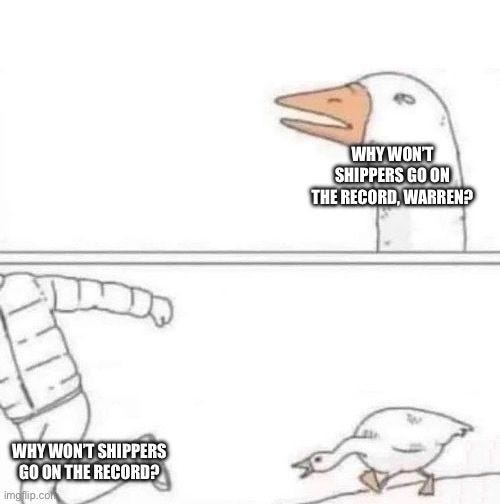
And it’s not just the White House. I’ve heard from more than one person in DC about their surprise at the lack of engagement from certain prominent Class 1 constituents in this Anti-Merger camp. Do they care? It certainly isn’t the urgent, pull-out-all-the-stops effort one would expect if you truly believed this was the endgame.
But maybe they don’t believe it’s the endgame, or at least they don’t believe the merger will get approved. That’s fine, but why aren’t you hedging your bets?
I’ve already written about the lack of a key figure from the Anti-Merger crowd who is willing to stick their neck out and sit down with the President in the White House. Engaging directly with this Administration and not doing so through a trade association is exactly what’s missing. The “strongly worded letter” is a waste of time with this Administration, especially when your opposing side is shaking hands and kissing babies. Which tactic is harder to ignore?
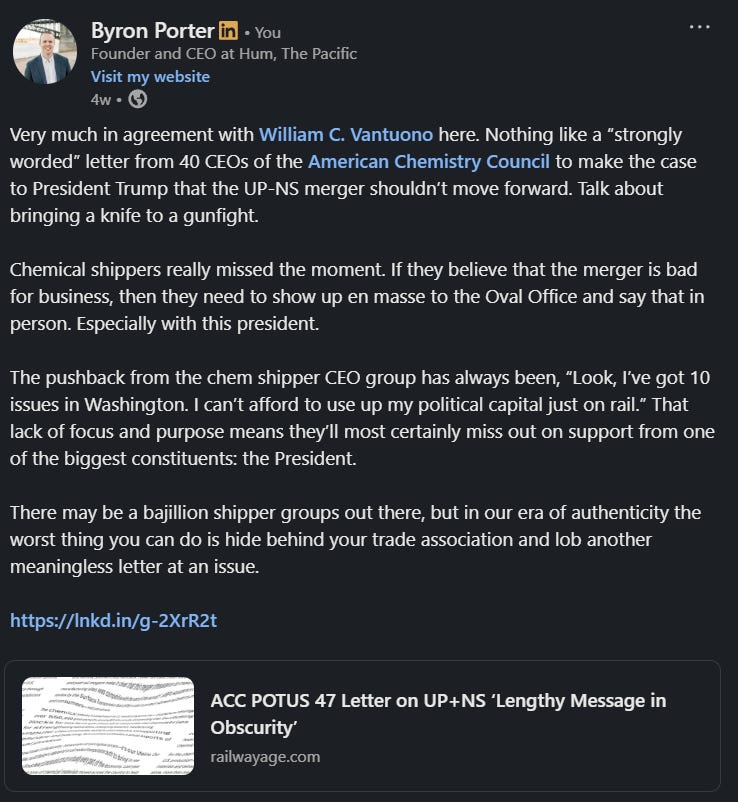
But maybe the shippers are okay with that? Part of this whole dog and pony show is really just posturing and positioning to extract the most value from this transaction, other Class 1 railroads included.
3. There’s still a lot of misunderstanding about rail mergers
I write off most of the for/against articles that I see from time to time because they’re largely recycled slop. Just like the old Wikipedia game, 5 clicks to Kevin Bacon, it doesn’t take that long to figure out the author is writing more out of a commitment to their favored ideology rather than to any real substantive understanding of the rail industry.
Take for example, this beauty published in Railway Age last week.
I don’t know this guy from Adam so I don’t want to dump all over his article, but what?? There are so many issues with it. Here’s two:
“As the new, combined company finds ways to make its network more efficient, shippers and consumers will ultimately benefit from those savings. This will help tamp down the inflationary pressures of the past few years and deliver price relief.” - What?
This is the biggest one, the assumption that value from increased economies of scale captured through consolidation will accrue to the shipper. Sure, if the service gets better, shippers could see cost savings in terms of reduced fleets and less inventory carrying costs. That’s something. (Not that there’s any guarantee shippers would play with reduced inventories, but theoretically it’s there). HOWEVER, at what point in time in the past 20 years have the railroads passed on their savings to their customers?
They’ve done the opposite. As PSR proliferated through the industry, the resulting cost savings from reduced CAPEX and fewer crews accrued to the shareholders in the form of greater and greater stock buybacks. Shippers were treated to ever larger and more frequent rate increases. Some can and have argued that the Class 1’s are only hitting the merger button now because they no longer are able to push price increases to fuel EPS growth.
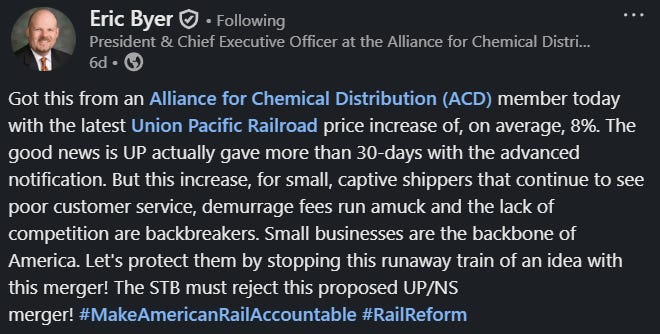
“Greater leverage in negotiations with trucking companies” - ??? Pray tell, why would a shipper struggle with leverage in a market with about a million options to choose from, any of which the shipper could simply pick up the phone and get access to today? That’s leverage. A market with fewer options than I have fingers on my right hand does not grant the shipper any leverage whatsoever.
If this merger truly were to deliver greater leverage to shippers, then why would 64 shipper trade associations come out against it? Especially those steeped in the rail industry like the American Chemistry Council (ACC), the American Fuel & Petrochemcial Manufacturers (AFPM), and the National Industrial Transportation League (NITL).
This isn’t to say the whole article is wrong - there are very valid points - but my goodness, let’s get on the same page here. Rail has been bleeding volumes for decades and it’s not because there isn’t a US transcon. It’s because the Class 1’s have largely ignored their customers and pursued an anti-growth, profitability-maximizing strategy that extracted as much value out of these customers as they can get away with.
===================================
Despite all these recent events and posturing from both sides, not much has really changed. There’s a path with a good chance of success that UP will be able to get their merger approved. The STB will ask for a large stack of concessions. UP will have to decide if it can live with what the STB is going to demand they give up. Maybe UP will walk away, but given the investment and careers staked on this merger going forward, is there really any world where UP doesn’t take the deal from the STB? I don’t think so.
Could not have said it better myself. Cheers